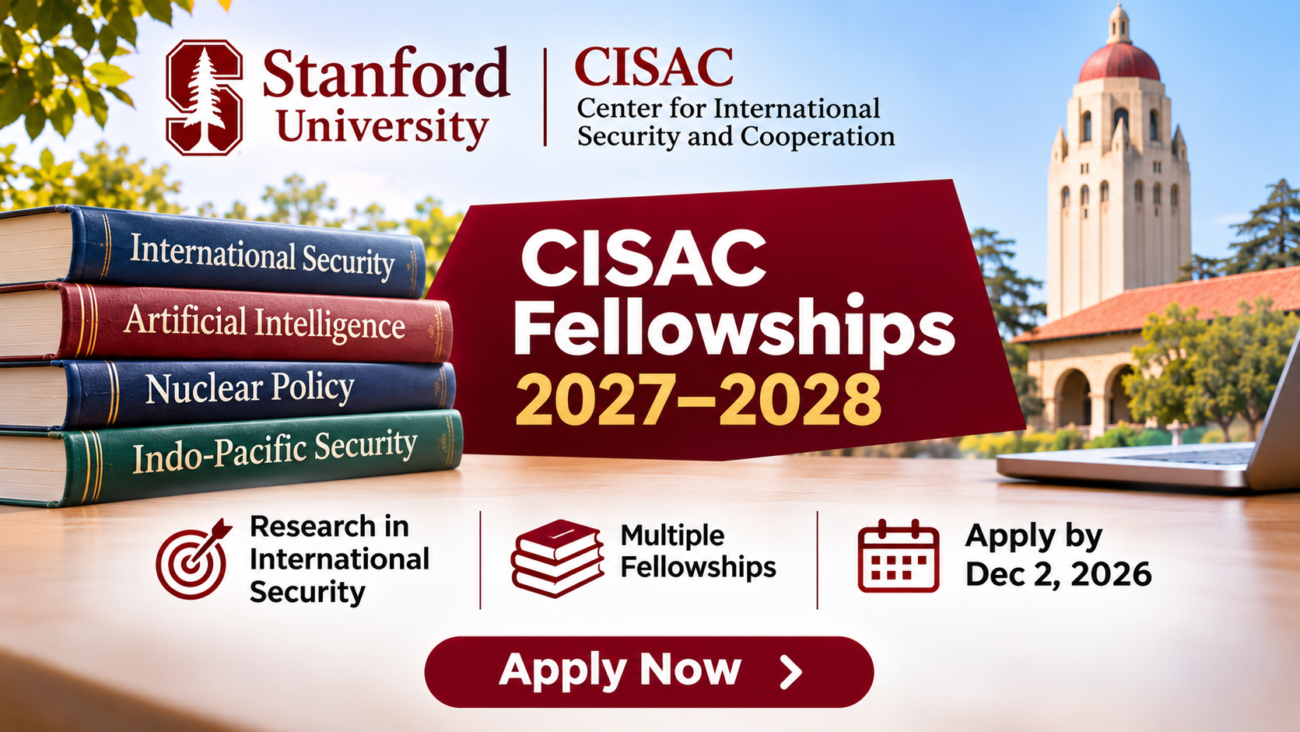
Stanford University CISAC Fellowships 2027–2028 – Fully Funded Research Opportunities in International Security
Stanford University’s Center for International Security and Cooperation (CISAC) is inviting applications for its 2027–2028 Fellowship Program. The programme offers research opportunities for scholars, researchers, scientists, engineers and policy professionals interested in addressing critical international security challenges.
The fellowships provide an opportunity to spend an academic year or longer at Stanford University conducting research, collaborating with leading academics and contributing to policy-relevant scholarship.
Research areas include nuclear security, artificial intelligence, cybersecurity, global governance, international relations, military competition, biosecurity and Indo-Pacific security.
Applications are open to candidates from the United States and other countries, with no citizenship restrictions specified in the general programme announcement.
Application deadline: 2 December 2026.
About Stanford CISAC
The Center for International Security and Cooperation is based at Stanford University’s Freeman Spogli Institute for International Studies.
CISAC brings together scholars and practitioners from different disciplines to examine international security challenges and develop research that informs policy and decision-making.
Its fellowship programme supports researchers interested in advancing knowledge on issues affecting international peace, security and global cooperation.
Fellows become part of an academic community that combines scientific research, policy analysis and interdisciplinary collaboration.
Available Fellowship Opportunities
For the 2027–2028 academic year, CISAC offers several fellowship opportunities across different research areas.
1. Artificial Intelligence and Laws of Armed Conflict Fellowship
This one-year, project-specific postdoctoral policy fellowship examines whether humans or artificial intelligence systems are more likely to comply with the laws of armed conflict during war.
Research will investigate human decision-making failures, AI vulnerabilities and the potential effects of integrating human and artificial intelligence systems into military decision-making.
Activities may include designing surveys, developing military scenarios, facilitating wargames, working with AI agents and analysing quantitative data.
Ideal candidates will have a JD, LLM and/or PhD in a relevant discipline, alongside experience in experimental research, behavioural data analysis or AI applications.
2. Artificial Intelligence in Strategic Stability and Military Competition Fellowship
This one-year postdoctoral fellowship examines the implications of artificial intelligence for strategic stability and military competition.
Research focuses on AI applications in nuclear command and control, nuclear deterrence and military decision-making.
Fellows may examine budget documents, design experimental wargames, analyse quantitative data and conduct expert interviews.
Applicants should hold a PhD in a relevant discipline and have experience with experiments or behavioural data analysis.
3. Fellowship on Indo-Pacific Security
This is a two-year postdoctoral fellowship focusing on US strategy and China.
The fellow will contribute to research projects examining US nuclear strategy towards China, alliance politics, deterrence and escalation dynamics in the Indo-Pacific region.
Responsibilities also include teaching and managing activities within the Stanford Indo-Pacific Policy Lab.
4. Geopolitics of Artificial Intelligence Fellowship
This one-year postdoctoral policy fellowship examines the geopolitical implications of global competition in artificial intelligence.
Research focuses on how the United States and its allies can compete internationally in AI development while addressing risks involving cybersecurity, AI governance, export controls and technological sovereignty.
Applicants should hold a PhD in a relevant discipline or a JD and demonstrate the ability to work across social science, law and technology policy.
5. India-US Security Studies Fellowship
These fellowships support early-career scholars, including predoctoral researchers, postdoctoral researchers and junior faculty.
Research areas include Indian foreign and defence policy, US-India-China security relations, security challenges affecting South Asia and the Indo-Pacific, and the India-US strategic partnership.
Fellows receive one year of research support at Stanford and opportunities for collaborative research in the United States and India.
The programme is sponsored by the Motwani Jadeja Family Foundation.
6. International Security Fellowship
This fellowship supports research across a broad range of international security issues.
Eligible research themes include nuclear weapons policy, cybersecurity, biosecurity, global health, terrorism, civil conflict, migration, global governance and international cooperation.
The fellowship is co-sponsored by the Carnegie Corporation of New York.
7. Natural Sciences or Engineering International Security Fellowship
This opportunity is intended for researchers with backgrounds in natural sciences and engineering.
Fellows can use their technical expertise to investigate the relationship between scientific developments, policymaking and international security.
The programme also provides opportunities to strengthen science communication skills.
8. Nuclear Security Fellowship
The Nuclear Security Fellowship supports policy-relevant research in three main areas:
- Nuclear weapons policy in a changing global environment.
- Nuclear terrorism and international movements of nuclear materials and knowledge.
- Nuclear energy and nonproliferation challenges.
The programme welcomes engineers, scientists and social scientists interested in advancing research and policy understanding of nuclear security.
Who Can Apply?
CISAC considers applications from researchers in the United States and internationally.
The programme welcomes scholars from different academic and professional backgrounds, including women and minority applicants, and does not impose a general citizenship restriction.
However, individual fellowships have different academic qualifications and experience requirements.
Depending on the fellowship, applicants may need a PhD, JD or LLM, while some opportunities also accommodate predoctoral researchers and junior faculty.
Candidates should review the specific requirements of their preferred fellowship before applying.
How to Apply
Interested candidates should submit their applications through the official Stanford CISAC fellowship application portal.
Application deadline: 2 December 2026.
Final Thoughts
The Stanford CISAC Fellowship Program 2027–2028 offers researchers an opportunity to contribute to important international security debates while working within a leading interdisciplinary academic environment.
With opportunities spanning artificial intelligence, nuclear security, international relations, engineering and global governance, the programme accommodates a diverse range of research interests.
Researchers interested in international security, emerging technologies and global policy challenges should explore the available fellowship opportunities and submit their applications before 2 December 2026.
