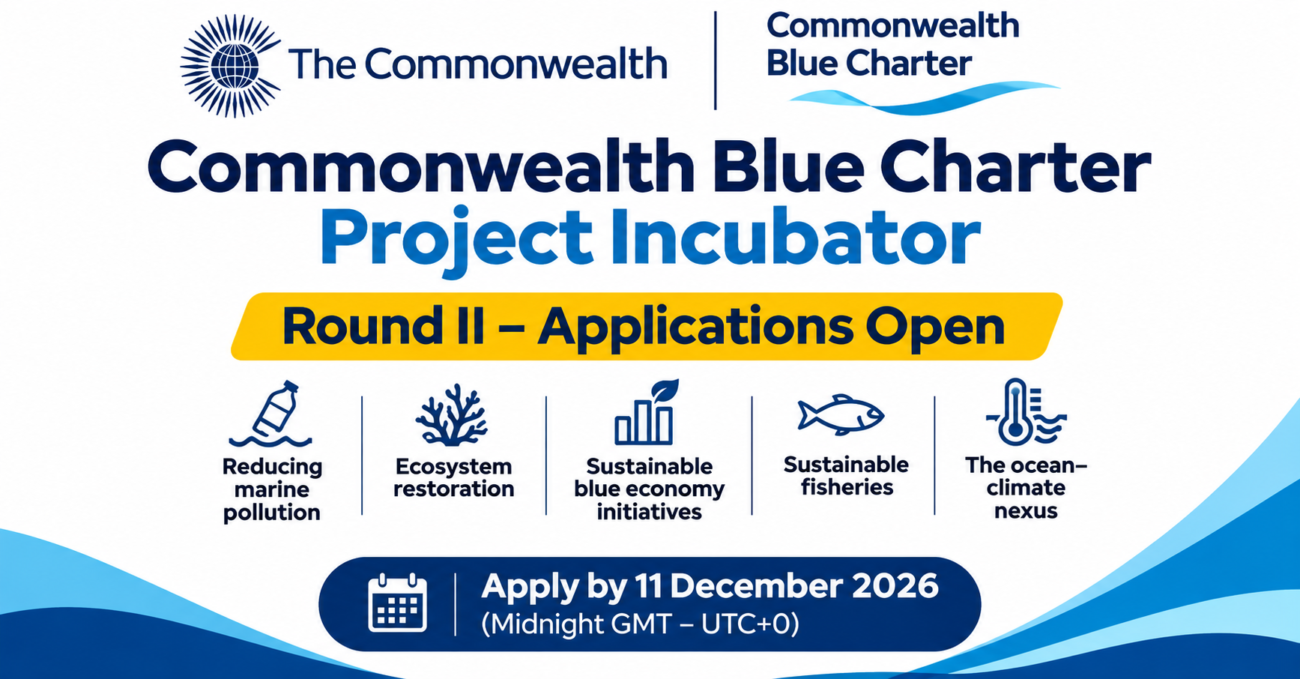
Commonwealth Blue Charter Project Incubator Round II 2026 – Apply by 11 December
The Commonwealth Blue Charter Project Incubator Round II is now accepting applications from eligible Commonwealth governments seeking support for ambitious projects addressing major ocean challenges and advancing sustainable blue economies.
The application window is currently open, with submissions accepted until 11 December 2026 at midnight GMT (UTC+0).
The programme provides early-stage catalytic funding of up to £50,000 to support government-led projects, including initiatives developed through partnerships between governments and non-governmental organisations or private-sector organisations.
The Commonwealth Blue Charter Project Incubator is designed to help promising ideas move from the early stages of development towards scalable pilot projects and proof-of-concept initiatives capable of influencing long-term ocean policy, regulation, legislation and investment.
What Is the Commonwealth Blue Charter Project Incubator?
The Commonwealth Blue Charter Project Incubator was launched at the Commonwealth Heads of Government Meeting (CHOGM) in June 2022 as a mechanism for supporting innovative ocean initiatives across Commonwealth countries.
The programme recognises that addressing complex ocean challenges requires practical projects that can demonstrate what works and generate evidence for wider implementation.
Through catalytic grants and technical support, the Incubator helps governments develop projects that can contribute to sustainable ocean development while strengthening national capacity and creating opportunities for future investment.
The programme focuses on five major priority areas:
- Reducing marine pollution
- Ecosystem restoration
- Sustainable blue economy initiatives
- Sustainable fisheries
- The ocean–climate nexus
These areas are aligned with the priorities set out in the Apia Commonwealth Ocean Declaration, which provides an important framework for Commonwealth cooperation on ocean sustainability.
Funding Available
Successful projects can receive up to £50,000 in early-stage funding.
The funding is intended to act as catalytic support, helping governments test innovative approaches, develop pilot projects and generate evidence that can support future policy and investment.
The Incubator is particularly relevant to initiatives that have the potential to move beyond a small-scale intervention and contribute to broader changes in how ocean resources are protected, managed and sustainably developed.
Projects may involve partnerships between governments and NGOs or private-sector organisations, creating opportunities for different stakeholders to contribute technical expertise, implementation capacity and innovation.
Who Supports Round II?
The second round of the Commonwealth Blue Charter Project Incubator is supported by several organisations.
The Commonwealth Fund for Technical Cooperation (CFTC) provides core support for technical assistance and capacity building.
The Prince Albert II of Monaco Foundation provides dedicated support for projects in South Asia and Pacific Small Island Developing States (SIDS).
The CAF – Development Bank of Latin America and the Caribbean provides dedicated support for projects in the Commonwealth Caribbean.
This combination of funding and technical support is intended to help participating countries develop practical initiatives that can contribute to stronger and more sustainable ocean economies.
Lessons from Round I
The first round of the Blue Charter Project Incubator demonstrated the potential of targeted support for innovative ocean projects.
Round I was initially supported through a contribution from the Commonwealth Fund for Technical Cooperation, with additional commitments from Bloomberg Philanthropies’ Vibrant Oceans Initiative.
Following a rigorous screening and due diligence process, eight projects were selected from Barbados, Canada, Fiji, Kiribati, Nigeria, Seychelles and Sri Lanka.
The projects addressed a range of ocean challenges, including plastic pollution, ocean science, mangrove management and marine litter.
The experience from Round I provides a foundation for the second round and highlights the importance of supporting projects that can produce practical results while contributing to wider ocean policy and sustainable development.
Why Apply?
The Commonwealth Blue Charter Project Incubator offers governments an opportunity to obtain funding and technical support for innovative ocean projects that may otherwise struggle to secure early-stage resources.
For countries facing challenges such as marine pollution, ecosystem degradation, unsustainable fishing or climate-related impacts on coastal communities, the programme can help transform an idea into a structured pilot initiative.
The funding can also help generate evidence and lessons that may support future policy reforms, larger investments and the scaling of successful interventions.
The programme is particularly relevant for governments seeking to connect ocean conservation with sustainable economic development.
Application Deadline
Applications for Commonwealth Blue Charter Project Incubator Round II are open until:
Deadline: 11 December 2026
Time: Midnight GMT (UTC+0)
Applicants should review the official programme guidance carefully and ensure that their proposals meet the relevant eligibility and project requirements before submission.
How to Apply
Interested applicants can access the application guidance and application form through the official Commonwealth Blue Charter Project Incubator Round II webpage.
The programme is an opportunity for Commonwealth governments to develop innovative, practical and scalable solutions to some of the world’s most pressing ocean challenges.
With funding of up to £50,000, technical assistance and support from international partners, the second round of the Incubator provides a potential pathway for promising ocean initiatives to move from concept to implementation.
Governments and eligible partners working in marine pollution, ecosystem restoration, sustainable blue economies, fisheries or the ocean–climate nexus should consider applying before the 11 December 2026 deadline.
