Many people worry that artificial intelligence will take their jobs.
Others worry about robots replacing workers.
But according to the World Economic Forum’s Future of Jobs Report 2025, the real story is bigger than that.
The report shows that millions of jobs around the world are expected to change over the next five years. Some jobs will grow. Some jobs will disappear. Many jobs will simply look very different by 2030.
This does not mean that work is ending.
It means that the world of work is changing faster than ever before.
The important question is not whether jobs will change.
The important question is: Which jobs are most at risk?
A Global Shift Is Already Underway
The World Economic Forum surveyed more than 1,000 employers representing over 14 million workers across 55 economies.
Their message was clear.
Technology, artificial intelligence, automation, economic changes, climate change, and demographic shifts are all reshaping the labour market.
As a result, some jobs are becoming less important while others are growing rapidly.
According to the report, job creation and job loss will affect about 22% of today’s jobs by 2030. Around 170 million new jobs are expected to be created, while about 92 million jobs may disappear.
That means workers need to understand where change is happening.
The Jobs Most at Risk
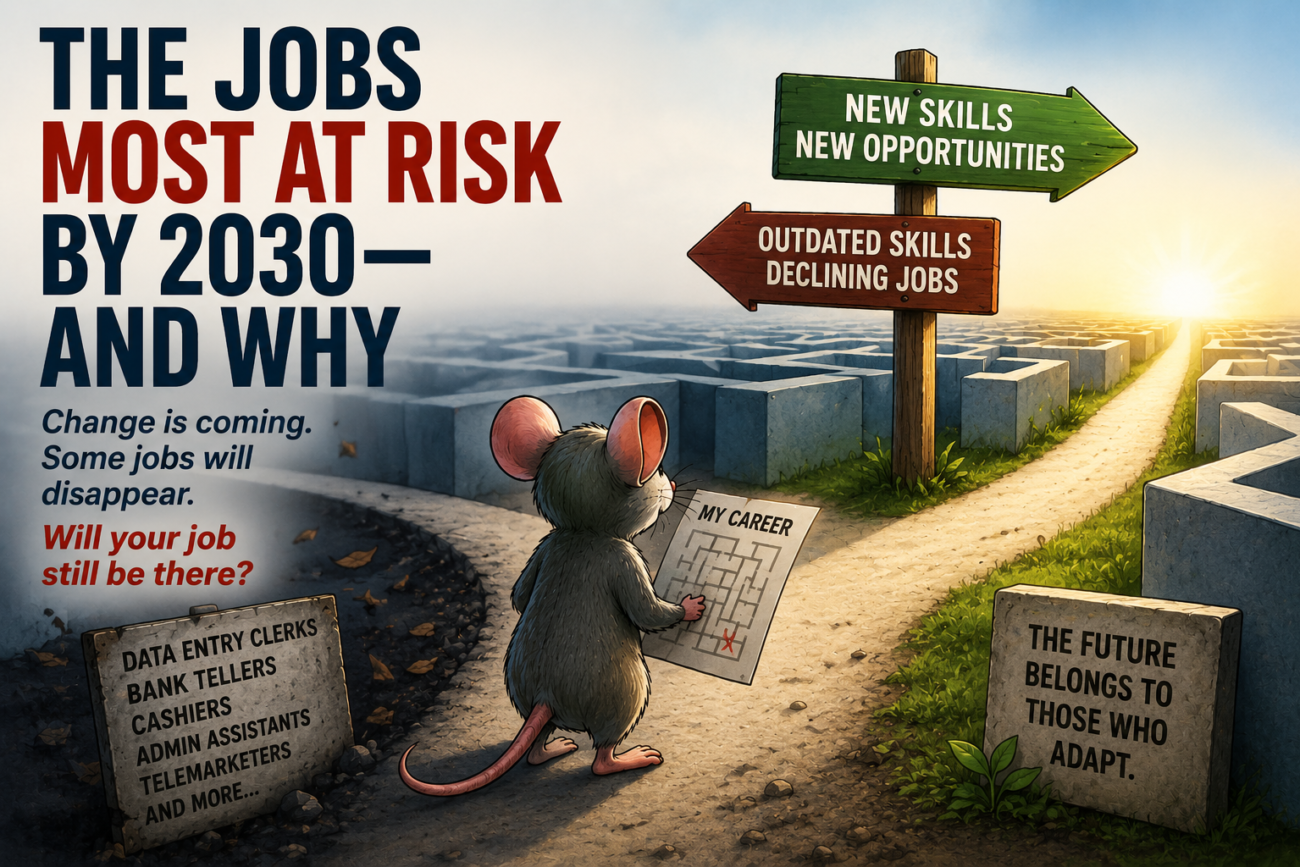
The report identifies several occupations that are expected to decline over the next five years.
Among the fastest-declining roles are:
• Data Entry Clerks
• Bank Tellers
• Postal Service Clerks
• Administrative Assistants
• Executive Secretaries
• Accounting, Bookkeeping and Payroll Clerks
• Cashiers and Ticket Clerks
• Telemarketers
• Printing Workers
• Material-Recording and Stock-Keeping Clerks
At first glance, these jobs may seem very different.
But they share one important characteristic.
Many of their daily tasks follow clear rules and repeat the same processes again and again.
Why These Jobs Are Declining
Technology is making many routine tasks easier and faster.
For example, customers can now:
• Buy tickets online
• Transfer money using mobile apps
• Check bank balances without visiting a branch
• Pay bills electronically
• Use self-service checkout machines
• Store records digitally
Because of these changes, employers need fewer workers to perform some traditional administrative tasks.
Artificial intelligence is also helping businesses process information, organize records, answer basic questions, and complete repetitive work more efficiently.
This does not mean humans are no longer needed.
It means businesses need fewer people doing routine work and more people solving problems, making decisions, and working with technology.
The Bank Teller Example
For many years, bank tellers helped customers perform basic transactions.
Today, much of that work can be done through mobile banking applications, ATMs, and online platforms.
Banks still need employees.
But increasingly they need people who can provide financial advice, build customer relationships, and solve complex problems.
The role is changing rather than disappearing completely.
The Data Entry Challenge
Data entry jobs face similar pressure.
In the past, organizations needed workers to manually enter information into systems.
Today, software can automatically collect, organize, and process large amounts of data.
This reduces demand for manual data-entry work.
At the same time, demand is growing for workers who can analyze that data and turn it into useful insights.
This is one reason why Data Analysts and Big Data Specialists appear among the fastest-growing jobs in the report.
Does This Mean Your Job Is Unsafe?
Not necessarily.
The report is not saying that everyone working in these occupations will lose their jobs.
Instead, it highlights where demand is expected to decline.
Many workers will adapt by learning new skills.
Others may move into related roles that are growing.
For example:
• A cashier could move into customer experience roles.
• A bookkeeper could learn financial analysis tools.
• An administrative assistant could develop project management skills.
• A bank teller could move into financial advisory services.
The future often rewards adaptation rather than starting over.
The Skills That Matter Most
The report highlights several skills that employers increasingly value.
Among the most important are:
• Analytical thinking
• Resilience and flexibility
• Leadership
• Social influence
• Technology literacy
• AI and data skills
• Cybersecurity knowledge
• Curiosity and lifelong learning
Notice something important.
Many of these skills are difficult for technology to replace.
Machines can process information.
Humans still excel at judgment, communication, creativity, leadership, and relationship-building.
The Bigger Lesson
The biggest risk may not be automation itself.
The biggest risk may be standing still while the world changes.
The Future of Jobs Report shows that many jobs are evolving, not disappearing.
Workers who continue learning, adapting, and developing new skills are likely to find new opportunities even as old roles decline.
The future of work is not simply about technology replacing people.
It is about people learning how to work differently.
What This Means for You
If your job involves routine, repetitive tasks, now is the time to think about future skills.
Ask yourself:
• Which parts of my job can technology do?
• Which parts require human judgment?
• What new skills can I learn this year?
• How can I become more adaptable?
The workers who succeed in 2030 may not be the most experienced.
They may be the people who are most willing to learn.
Read Next
The Jobs Growing Fastest in the World Right Now: What the Future of Work Looks Like by 2030.
Source: World Economic Forum Future of Jobs Report 2025. The report found that approximately 39% of current worker skills are expected to be transformed or become outdated by 2030, while a majority of workers are expected to require training or reskilling during the same period.
The World Economic Forum Just Issued a Career Warning: 39% of Your Skills Could Be Outdated by 2030
